

BLOG

February shoot behind the scenes
Our February photoshoot for book 2 was shallow table centre arrangements using pin holders . Here’s some of our behind the scenes photos.
A big part of The British Flowers Book is the photoshoots using seasonal flowers in “real life” situations that we’d supply flowers for .
For our book 2 photo shoots, we wanted to make sure we used only sustainable floristry methods, and in readily available, in season flowers. For February we created table centres with shallow bowls and kenzan pin holders to support the flowers
A Photoshoot is a great way of showing off floristry, without having to be under a time constraint of handing over a display to a customer, but that does mean that sometimes displays made specifically for photoshoots, might stretch the truth about what would be easily accessible, or are unrealistic in what would be included in a customer budget.. We wanted to use real life models (us, the British flowers book team) and the actual flowers that are available., and also assess how long they lasted when the camera went away. Our behind the scenes photos show you how we actually got the shots, In February this was using the greenhouse cleared of plants, and a table to take the photos on.

We’d chosen another dull and wet day for the photoshoot, so Kerry did well to get the greenhouse to look bright and the displays cheerful


These flowers were all in water, and the weather was cold but not freezing, so the flowers lasted really well in their vases, and only faded when they ran out of water.
We also learnt that if you hang a hair band in a tree, the wind will catch it , and you will get to see all the wire and tape gubbins!


The Wholesaler interview - Helen Chambers of Evolve flowers
Lincolnshire Wholesaler Helen Chambers of Evolve flowers tells us about her background in floristry and how her background and deep knowledge of the supermarket flower trade enables her to connect with the growers and florists who need a year round flower supply.
Helen is based in Spalding Lincolnshire, among the centre of the British Commercial flower growers. She has built Evolve over the last 5 years and her background in floristry means she knows how you can make your floral art profitable
Who are you, and what’s the background to Evolve flowers?
I’ve got a background in Floristry, and have many years experience of working with designing lines for Supermarkets to be beautiful and profitable both here in the UK and abroad. I’ve been based in Lincolnshire and worked with lots of the large pack houses and supermarket distribution centres, so I know how the wholesale industry works, and the key growers who are supplying the market. I’ve been involved in lots of floristry eduction and Evolve developed from a desire to teach more about our home grown industry

Always cheerful, Helen showing off Evolve.
What is your season?
We work closely with our suppliers to ensure a year-round supply of British flowers. In winter, we bring in hydroponic tulips and muscari, while summer sees an abundance of blooms from growers across Lincolnshire. Alongside fresh flowers, we also offer a wide range of sundries, including mechanics and vases, florist supplies, and dried flowers, making it easy for florists to source everything they need in one place.
Who’s your ideal customer?
We supply a mix of florists, from those needing a regular stock for their shops to event florists looking for large quantities of blooms. We welcome all British flower arrangers, but we’d love to see more customers committing to a consistent supply—regular orders help us plan ahead and support our growers more effectively.
What changes have you seen in the last six years (since the British Flowers book was published) in what florists are buying?
Interest in British flowers has grown significantly, which is fantastic to see. However, the market has also become more unpredictable, with fluctuations in trade, peaks and troughs in demand, and some larger suppliers going out of business. The weather plays an increasing role in availability, and we’re all having to stay adaptable. Florists are often order at the last minute, which makes supply more tricky, but our investment in our website really helps
Any predictions for what will be popular next year?
We expect to see more demand for accessories that enhance displays without increasing costs—florists will be looking for creative ways to add impact while keeping arrangements profitable. Floral artistry will continue to evolve, ensuring customers get value for money while florist shops remain sustainable businesses.

Helen demonstrating at one of her Education days, - highly recommended, this was a visit to Collisons Tulips

What's available from flower farms in the UK in February
What’s available from the flowers farms and wholesalers of the UK in February
The glasshouses and polytunnels of the UK provide enough shelter to produce amazing blooms of tulips, anemones, alstroemerias and muscari, and with narcissus coming from the sheltered fields and warmer climes of the Isles of Scilly and Cornwall, there is plenty for showing the love in February.
Tulips
For every florist, February means Valentine’s romance. But for the British flowers growers still in the grip of winter, there’s no chance of rose blooms. Instead we can offer our customers the following seasonal flowers


Alstroemerias are a dry crop that needs minimal water and heat, so we can get flowers all through the season. Anemones and Leucojum are available from Cornwall, and Hellebores in small numbers from Lincolnshire.


There is still plenty of winter foliage available like our January stalwarts of Pittosporum, Eucalyptus, Rosemary and Senecio, but in February there is also “twiggage” from Cornus, Hazel, Pussy willow and Curly willow.

For your Winter flowers, choose one of these British Flowers wholesalers.
Smith and Munson , Flower by Clowance, Evolve Flowers Wholesale, BJ Richards, Real Flower company trade Crosslands Alstroemerias
The British Flowers Book 2 – Now Available to Pre-Order!
It’s happening! The second edition of The British Flowers Book is on its way, and I’m thrilled to share that it’s now available for pre-order, with delivery in time for Easter.
This edition has been a real labour of love, packed with 12 new monthly photoshoots of sustainable floristry inspiration, 28 new seasonal themes and conditioning advice for 168 flower varieties—all designed to help florists work with the seasons, make informed choices, and inspire their customers. If you’re looking for practical guidance on selecting in-season colours, conditioning flowers for longevity, understanding sustainability, and creating plastic-free designs, this book is for you.

It’s happening! The second edition of The British Flowers Book is on its way, and I’m thrilled to share that it’s now available for pre-order, with delivery in time for Easter.
This edition has been a real labour of love, packed with 12 new monthly photoshoots of sustainable floristry inspiration, 28 new seasonal themes and conditioning advice for 168 flower varieties—all designed to help florists work with the seasons, make informed choices, and inspire their customers. If you’re looking for practical guidance on selecting in-season colours, conditioning flowers for longevity, understanding sustainability, and creating plastic-free designs, this book is for you.
Why Pre-Order?
Pre-orders help me fund production costs upfront, ensuring that I can bring this book to life and get it into your hands as soon as possible. The first edition was made possible thanks to a wonderful community of flower lovers who supported my Crowdfunder. This time, I’m taking the leap and funding it myself—but I still need your support to make it happen.
By ordering now, you’re guaranteeing yourself a copy of the book before it officially launches, and you’re also directly supporting independent publishing and the promotion of seasonal, sustainable British flowers.
What’s Inside?
This book has been written with florists in mind, but is also a fantastic resource for flower growers and anyone passionate about British flowers. It covers:
🌸 Seasonal colour selection – Understanding how to choose and design with flowers that are naturally at their best throughout the year.
💐 Conditioning for lasting vase life – Practical, detailed advice on how to care for flowers to ensure they stay fresh.
🌿 Sustainability and flower choices – How to make informed decisions that support British growers and reduce environmental impact.
♻️ Plastic-free floristry techniques – Creative ideas for reducing waste in floral design.
Already have the first edition?
This new version builds on everything that made it so popular. The much-praised seasonal themes and colour photography—showcasing flowers growing in the field—remain at the heart of the book. But this edition brings up-to-date floristry inspiration, conditioning instructions for 58 additional blooms, and refreshed images throughout, making it an even more valuable resource for florists and flower lovers alike.
I can’t wait to share this new updated edition with you, and I’d be so grateful if you could support the book by pre-ordering your copy today.
Click here to place your order and be part of this next step in championing British-grown flowers!
Thank you, as always, for being part of this journey with me. Your support means the world.


Smith and Munson Tulips
5th Generation Growers Smith and Munson are based in the Lincolnshire Fens. Here I talk to Jo Munson about their Tulip and Lily growing, and what she thinks florists will be looking for this year.
Q&A with Jo Munson: Growing Tulips and Lilies in the Lincolnshire Fens
Tell us a bit about yourself and where you’re based.
We’re based in Gedney, Lincolnshire, right in the heart of the Fens. It’s an area known for its flat landscapes, rich soil, and an abundance of flowers. In fact, 200 million tulips are grown hydroponically around here each year! and we grow 10million here , with lilies being our other main crop.
We supply florists and wholesalers, focusing on fresh, high-quality British flowers delivered straight from the farm.
Read more about the 5 generations of Smith and Munson here

What’s your main selling season?
Tulips are our star crop, starting just before Christmas and peaking between early January and mid-May. With a large proportion of the crop sold at the peak weeks of Valentines and Mother’s Day
Our lilies between July and November are sold in bunches of five and wrapped in paper for an eco-friendly touch. Beyond these, we also grow peonies, snowberries, pussy willow, white lion cytisus, rosehips, eryngium, green globe, sanguisorba tanna, astrantia, hypericum, ranunculus, and scabious.
Who’s your ideal customer?
We love working with event florists who value fresh, local flowers. We pride ourselves on excellent customer service, ensuring our flowers leave the farm at 3:30 pm and are with florists by noon the next day, thanks to DPD’s overnight deliveries.

What changes have you noticed in the past six years in what florists are buying?
There’s been a noticeable shift towards British flowers, with more customers valuing provenance and sustainability. It’s wonderful to see the continued love for tulips—they’re such a cheerful sign of spring!
Hydroponics have also made a big difference, reducing the need for pesticides. Each bin holds around 25,000 tulip bulbs, and we’re growing more each year. However, bulb prices have gone up, reflecting the dramatic weather extremes last year and wider economic pressures.
What trends do you think florists will love next year?
Double and crown tulips are set to steal the show—florists are always looking for something a bit special. Sustainability is also becoming more than just a buzzword, with supermarkets increasingly labelling flower origins, - I wish they’d label all the flowers with their origin, not just the British grown ones. This transparency is a step in the right direction for the industry.

What's available from flower farms in the UK in January
January may be cold and dark, but there are still flowers to be found in the fields and greenhouses of our British growers
Usually the coldest and bleakest month, in January we are glad of greenhouse growers to add to the array of outside grown foliage and flowering shrubs.
Rosemary in the snow
In January it’s the month that all flower farmers would just like to stay indoors and plan their beds for the coming year. But customers still want flowers to brighten their days, and when the Christmas decorations are removed there is often a desire to replace with something colourful, so here’s what you’ll find available from the wholesalers and greenhouse growers in January.


Narcissus from the Isles of Scilly and daffodils from Cornish growers, January varieties are usually Soleil d’or, Early Cheerfulness and Scilly white. Anemones are available dependant on the weather - warmer conditions mean longer stems. Tulips are produced hydroponically so are a bright burst of winter colours, and Alstormerias are available throughout the year.


For your Winter flowers, choose one of these British Flowers wholesalers.
Smith and Munson , Flower by Clowance, Evolve Flowers Wholesale, BJ Richards, Real Flower company trade
Viburnum tinus
If you want to use flowers in the winter, one of the best sources of both flower and foliage is the flowering shrub that is Viburnum tinus.
If you want to use flowers in the winter, that are hardy and can be grown outside, one of the best sources of both flower and foliage is the flowering shrub that is Viburnum tinus.

Viburnum can grow to be a big shrub if left unpruned. Pruning in the winter (or live heading it for the floral displays) will ensure that it has fresh growth and fresh flowers for the following year.

The buds of Viburnums often start off pink, and open to soft pink flowers, which turn to white. It's easy to condition, and will even last out of water for most of a day for those all important bridal bouquets and buttonholes.
Here it is in a Winter bouquet paired with glasshouse grown Tulips , ranunculus and Anemone. and hazel catkins..

And for those all important wedding touches with paper white narcissus and winter flowering cherry.

Photo Emma Davies
and here it is used in our January photoshoot for Book 2 used for a floral headdress.


The Wholesaler interview - James Cock of Flowers by Clowance
Cornish Wholesaler of British flowers all year round, James Cock of Flowers by Clowance tells us about how he got started, and his thoughts for the future.
James was one of my first points of contact in The British flowers industry as we met in Cullompton at one of the first Flowers from the Farm inspired meetings there. I bought flowers for my first Valentines flower offering in 2013, and so it seems apt that we show off the wholesalers that keep our British flowers industry going all year round when smaller flower farms don’t have enough to offer to the public from their own fields
Who are you, and what’s the background to Flowers by Clowance?
I’m James Cock, a third-generation grower based in Cornwall. JT Cock was founded in 1943, and it grew into a family nursery producing stocks, chrysanthemums, alstroemerias, tulips, & gladioli, in their 100s of thousands. Chrysanthemums were our year-round crop, with other flowers following their natural seasons.
In the early 1990s, I went to Pershore college to study Commercial horticulture,, which helped us adapt during a difficult time for the British flower industry. By 2005, I launched an online platform to sell flowers by post, which gave the business a much-needed wider reach.
When my parents retired in 2017, I decided to transition from growing to creating a hub for British flowers. In early 2018, I established Flowers by Clowance at our own site. Now, we work with growers across the UK, providing a vital connection between producers and customers, and ensuring British flowers are available year-round.

James in among the stocks
What is your season?
We sell all year round, we have access to the Isles of Scilly for Narcissus and Cornish growers for Foliage and early season bulbs, plus we have a link through Trans flore to the Lincolnshire growers
Who’s your ideal customer?
We’ve a large number of florist customers on our list, and we love working with those who want bulk flowers for weddings or their shop, but we also work with florists in Falmouth and surrounding areas and have a van that serves them regularly.
What changes have you seen in the last 6 years (since the British flowers book was published) in what florists are buying.
There has been lots more access to flowers for florists and the public. There’s been more public awareness about flower miles, and there are changes to packaging happening, - less plastic already, but more focus on that in coming seasons
Any predictions for what will be popular next year?
Yes Quirky things seem to be in like Bridal Gladioli , Scented flowers always in fashion.


January shoot behind the scenes
Our January photoshoot for book 2 was showing off floral head crowns made with winter beauty. Here’s some of our behind the scenes photos.
A big part of The British Flowers Book is the photoshoots using seasonal flowers in “real life” situations that we’d supply flowers for .
For our book 2 photo shoots, we wanted to make sure we used only sustainable floristry methods, and in readily available, in season flowers.
A Photoshoot is a great way of showing off floristry, without having to be under a time constraint of handing over a display to a customer, but that does mean that sometimes displays made specifically for photoshoots, might stretch the truth about what would be easily accessible, or are unrealistic in what would be included in a customer budget.. We wanted to use real life models (us, the British flowers book team) and the actual flowers that are available., and also assess how long they lasted when the camera went away. Our behind the scenes photos show you how we actually got the shots (in this case on a cold January day between squalls of rain)
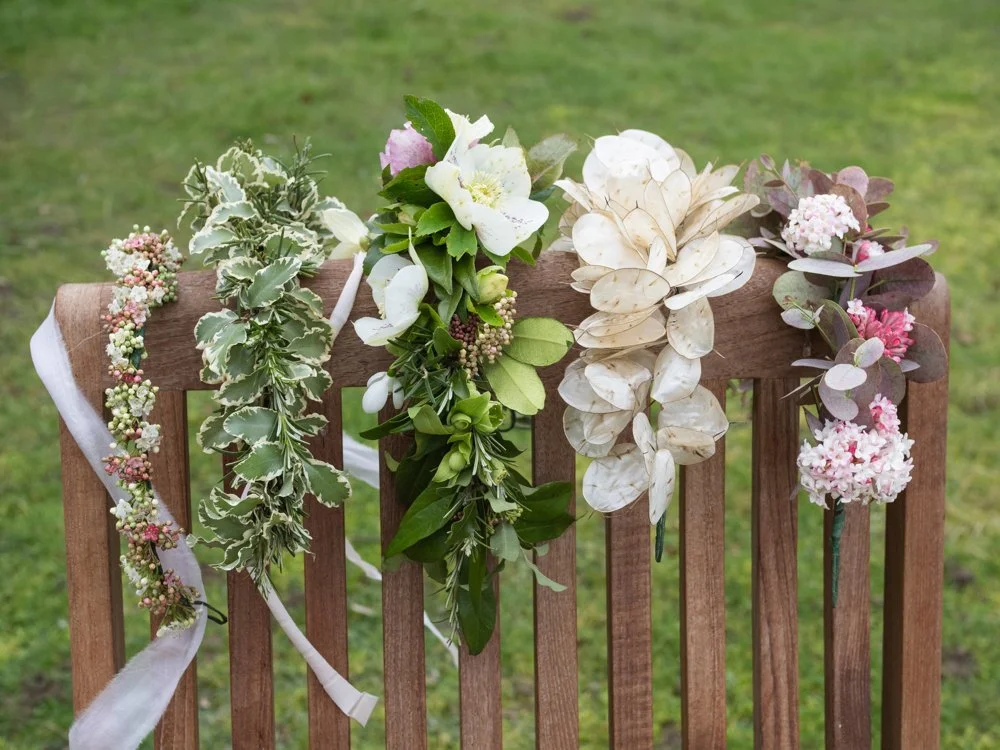
January 2024 was fairly mild, but very wet, so we used a combination of fresh flowers and dried honesty to make our Headbands. All were created by paper taping stems onto taped wire. Our ingredients were. Hellebores, Snowdrops, Clematis, Viburnum tinus, Viburnum bodnantense, Hazel catkins, Rosemary, Pittosporum and Eucalyptus.

We tested the longevity of all the flowers by leaving them on damp paper overnight, and even the Hellebores surprised us by remaining fresh until the next day. The honesty holds the record, as that’s still going strong in the barn almost a year later.

We also learnt that if you hang a hair band in a tree, the wind will catch it , and you will get to see all the wire and tape gubbins!


What's available from flower farms in the UK in December
What’s available from UK Artisan flower farmers in December
December is a month of Christmas decorations in the form of wreaths, garlands and displays. With lots of foliage and dried flowers and seed heads for decoration, there’s no reason Christmas decorations can’t all be UK grown, and with Chrysanthemums and Lilies available from wholesale growers, and the first hydroponic tulips arriving before Christmas, December is no long the dull month with no flowers.

Christmas decorations and foliage
Locally grown wreath rings in the form of willow, cornus and other flexible climbers are now replacing floral foam or even wire rings.
And even if those flowers don’t take your fancy, seasonal foliages are available for bouquets and displays.
Christmas half wreath

For your Winter flowers, choose one of these British Flowers wholesalers.
Smith and Munson , Flower by Clowance, Evolve Flowers Wholesale, BJ Richards, Real Flower company trade